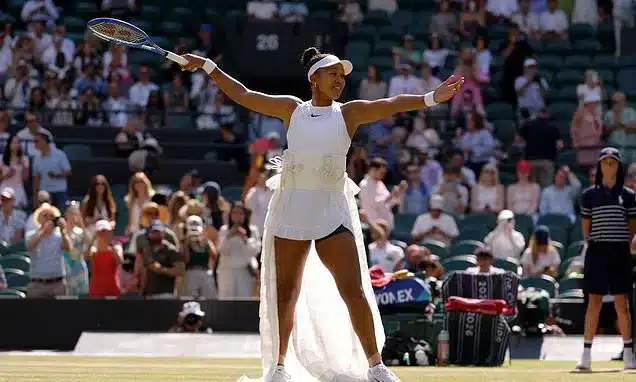
Naomi Osaka opted for a more understated look as she competed in the Wimbledon quarter-finals, a decision she linked to her stated goal of prioritizing her tennis performance. After making striking fashion statements in earlier rounds, Osaka appeared on court for her match against Karolina Muchova in a significantly simplified ensemble, foregoing the elaborate kimono she had previously worn.
A Shift Towards Tennis Focus
Osaka, who has been a notable presence at the All England Club this week, had previously captivated audiences with her unique walk-on outfits. For her initial matches, she embraced a traditional Japanese ceremonial dress, drawing inspiration from the film ‘Kill Bill.’ This distinctive attire featured an open kimono adorned with embroidered cranes and cherry blossoms, symbols of Japanese culture, paired with a wide obi belt and flowing tulle train.
However, in the lead-up to her quarter-final match, Osaka indicated a desire to streamline her presentation. “I definitely wanted to [mix it up] but I actually really wanted to focus on the match,” Osaka explained after her fourth-round victory over world No. 1 Aryna Sabalenka. “So that was me being very tame. There’s definitely a couple things I can add. Well, ironically I kind of want to focus on my tennis now, so I might dial back a little bit.”
True to her word, Osaka’s outfit for the quarter-final featured the obi belt and tulle train without the accompanying kimono. This marked a departure from her earlier appearances, where the kimono was a central element of her ensemble. Even in her second-round match against Anastasia Gasanova, she had worn the kimono over a Nike training top, but the latest iteration was even more pared down, with the obi belt and train serving as the primary decorative elements over her playing kit.
Wimbledon’s All-White Tradition and Osaka’s Interpretation
Wimbledon’s stringent all-white clothing policy presents a unique canvas for players. While adhering to the tradition, Osaka has consistently found ways to express her personal style and cultural heritage. Her earlier Wimbledon outfits were a testament to this, blending the tournament’s strict dress code with her distinctive flair.
The custom white kimono she wore for the first round was a meticulously designed piece, crafted from vintage Japanese bridal garments and wedding dresses. Tokyo-based designer Hana Yagi, who worked on the outfit, drew inspiration from traditional Japanese arts like kirigami. The ensemble, complete with deep bell-shaped sleeves and a kanzashi hair ornament historically worn by geisha, paid homage to both Japanese culture and iconic cinematic moments.
“When I think about Wimbledon, it’s obviously the all white,” Osaka had commented after her opening-round win. “It’s the oldest tournament, right? Then there’s obviously the tradition of it all. When I think about that, I think about my cultures, my heritage, which is Japanese and Haitian. Then if I dive deeper into like Japanese culture, I think about the most iconic silhouette, which for me is a kimono.” She further elaborated on the ‘Kill Bill’ inspiration, noting her admiration for Lucy Liu’s character’s all-white kimono.
The detachable nature of her outfits allowed Osaka to reveal a standard white Nike match dress underneath after the initial presentation, showcasing a practical approach to her elaborate designs. She found the reactions to her unique entrances amusing, noting the surprise and admiration from spectators and fellow players alike.
Fashion and Tennis: A Recurring Theme
Osaka’s approach to on-court fashion has often been a topic of discussion. At the recent French Open, her bold outfits, including a shimmering gold dress inspired by the Eiffel Tower and ensembles made from upcycled materials, led to some criticism. Her first-round opponent in Paris, Laura Siegemund, remarked that she came to play tennis, not put on a fashion show, a sentiment that highlighted a perceived tension between athletic performance and sartorial expression.
Osaka, however, has consistently defended her choices, viewing her walk-on attire as a form of self-expression and a way to engage with the entertainment aspect of professional sports. “Sometimes people say athletes in show business or entertainers or whatever,” Osaka stated. “I feel like, for me, Grand Slam walk-ons are the only time that I possibly feel like I’m an entertainer.” She also acknowledged the practical considerations, such as worrying her sparkling outfits might blind spectators.
Other players have also experimented with distinctive on-court fashion. American player Taylor Fritz, for instance, appeared in a custom all-white suit by Hugo Boss for his opening match at Wimbledon, drawing comparisons to Roger Federer’s style. While Fritz expressed some initial uncertainty about his look, he ultimately felt it presented well.
Osaka’s previous fashion highlights include a jellyfish-inspired outfit at the Australian Open and avant-garde jewelry at Indian Wells. Her foray into high fashion extended beyond the court, notably at the Met Gala, where she made a dramatic entrance with a ‘skin-shedding’ performance.
Conclusion: Balancing Style and Substance
Naomi Osaka’s decision to simplify her Wimbledon attire reflects a conscious effort to channel her energy and focus into her tennis matches. While her elaborate outfits have garnered significant attention and showcased her creative spirit, her latest choice underscores a commitment to performance. This shift demonstrates her evolving approach to competition, where personal style and athletic goals are carefully balanced, allowing her to make a statement both on and off the court through her play.