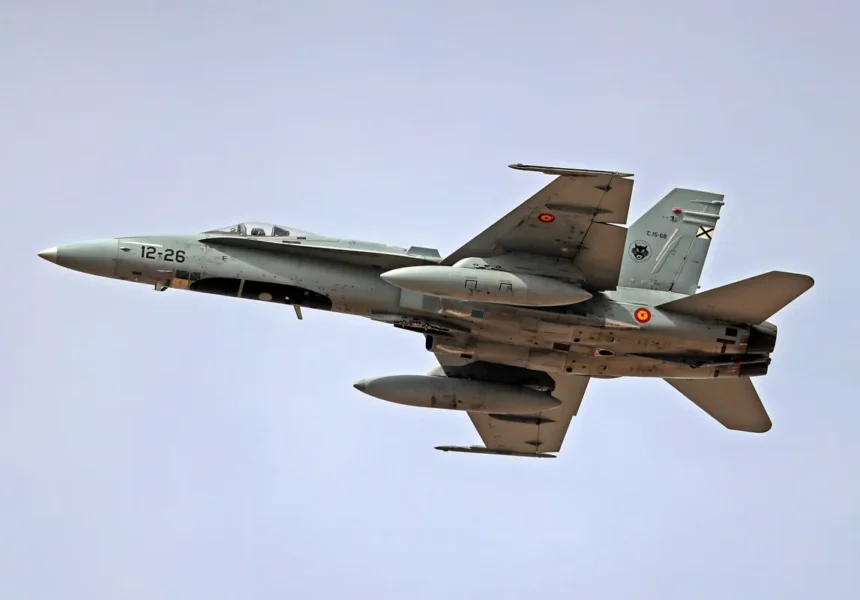
Two Spanish F/A-18 Hornet fighter jets belonging to NATO intercepted and shot down an unidentified drone that entered Romanian airspace early this morning. The incident occurred around 4:45 AM local time, with the unmanned aircraft being neutralized approximately 15 minutes later. Wreckage from the drone landed in an unpopulated area between two towns, according to Romania’s Ministry of Defence.
Drone Entry and Interception Details
While the drone’s origin remains unconfirmed, Romanian radar systems detected its entry into the country’s airspace from neighboring Moldova. The Romanian Ministry of Defence confirmed the interception and subsequent downing of the aircraft. This event highlights the ongoing need for vigilance and rapid response within NATO member states, particularly in Eastern Europe.
Romania’s Position on European Defence
Romania’s Defence Minister, Radu Miruță, emphasized the country’s critical role in the European Union’s defence framework. In a statement shared on social media, Miruță stated, “Romania is in the front line of defence of the European Union.” He further underscored the importance of allied solidarity, noting, “Romania is defending its airspace, and our allies stand with us. Vigilance, rapid response, and allied solidarity—these are the concrete guarantees of our security.”
Context of Airspace Violations in Romania
This latest incident marks the fourth drone to be shot down in Romanian airspace this year, according to reports from the news agency Reuters. Romania shares a significant 382-mile land border with Ukraine, and its airspace has been subject to incursions by Russian drones since the commencement of the war in Ukraine over four years ago. These repeated violations underscore the heightened security concerns in the region.
Previous Incidents and Regional Tensions
The proximity to the conflict in Ukraine has led to several concerning events within Romania and neighboring countries. In May, a drone, believed to be of Russian origin, struck an apartment building in the eastern Romanian town of Galați, which is situated near the Ukrainian border. This incident resulted in two injuries and a fire, necessitating an evacuation of the building.
Further afield, but within the broader context of regional security, a cruise missile, also suspected to be Russian, landed in a field in Poland last month, leaving a substantial crater. Meanwhile, an overnight missile and drone assault on Kryvyi Rih, the Ukrainian hometown of President Volodymyr Zelensky, tragically resulted in one fatality and six injuries.
Broader Impact of the Conflict
The ongoing conflict in Ukraine continues to have ripple effects across Eastern Europe, impacting the security posture of NATO members. The downing of the drone over Romania is a stark reminder of the potential for airspace violations and the importance of robust air defence systems and international cooperation. The incident reinforces the strategic significance of Romania’s position within NATO and its role in maintaining regional stability.
NATO’s Role in Air Defence
NATO’s collective defence principle means that an attack on one member is considered an attack on all. The deployment of Spanish fighter jets to intercept the drone demonstrates this principle in action. NATO maintains a continuous presence and conducts regular patrols in its member states’ airspace to deter aggression and respond to threats. The alliance’s integrated air defence system is designed to monitor and protect against aerial intrusions, ensuring the security of its territory.
Technological Advancements and Challenges
The increasing prevalence of drones in modern warfare presents both opportunities and challenges for military forces. While drones offer versatile capabilities for surveillance and attack, they also pose a complex threat to traditional air defence systems. The ability of NATO forces to detect, track, and neutralize these unmanned aircraft is crucial for maintaining airspace integrity. This incident underscores the ongoing adaptation and technological advancements required to counter evolving aerial threats.
Conclusion
The interception and downing of the drone over Romania by NATO fighter jets highlight the persistent security challenges faced by Eastern European nations in the current geopolitical climate. The swift response by Spanish F/A-18 Hornets, coupled with Romania’s emphasis on allied solidarity, demonstrates the effectiveness of NATO’s integrated air defence capabilities. As the conflict in Ukraine continues, vigilance and coordinated action remain paramount in safeguarding national airspace and ensuring regional security.