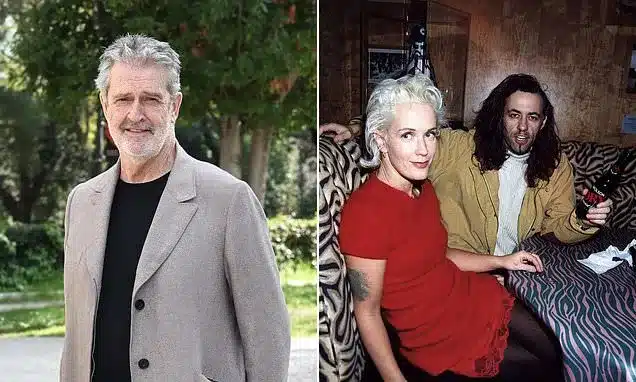
Rupert Everett, the outspoken actor known for his captivating performances and a life lived on the edge, has charted a remarkable transformation from his wild younger years to a more settled existence. Having achieved stardom with roles in 1984’s Another Country and the 1997 hit My Best Friend’s Wedding, Everett’s personal life often mirrored the dramatic narratives of his films.
A Hedonistic Past
Everett’s early adulthood was marked by a deliberate embrace of a hedonistic lifestyle. He has spoken openly about experimenting with heroin and engaging in sex work to support himself during his time in London. He left a privileged upbringing at 16, seeking a more raw and dramatic existence, once stating, “When I was a kid I wanted to smoke cigarettes, suffer and finish off as badly as possible.”
His journey into sex work, he explained, was not a planned pursuit but rather a consequence of being approached for money outside a London tube station. “I didn’t set out to hustle, but this guy offered me such a massive amount of money, well, it was like a year-and-a-half’s pocket money,” he recalled.
At 18, concerned parents sent him to live with a family in France to learn the language and find stability. However, his adventurous spirit led him to the Bois de Boulogne, where he encountered a transsexual sex worker and found himself immersed in that world. During this period, he also used heroin, though he maintained it did not impede his burgeoning career.
Feuds, Memoirs, and a Changing World
Everett’s breakthrough role as the lover of Colin Firth’s character in Another Country launched him into the Hollywood spotlight. He went on to star in acclaimed films and later took on the role of Julia Roberts’ gay best friend in My Best Friend’s Wedding.
His career was also punctuated by a famously protracted feud with his Another Country co-star, Colin Firth, which lasted two decades before they reconciled while working on The Importance of Being Earnest in 2002. Everett had described Firth as “boring,” while Firth labeled Everett a “monster.”
Everett’s tell-all memoirs, Red Carpets and Other Banana Skins (2006) and Vanished Years (2012), offered candid insights into his life, leaving few unscathed. He made pointed observations about public figures like Alistair Campbell and Alan Sugar.
The memoirs also revealed personal heartbreaks, including his decision to walk away from a relationship upon learning his then-boyfriend had been diagnosed with HIV. Everett has spoken about the pervasive fear and terror during the AIDS pandemic, recalling how even loved ones would take his plate away to be washed separately, a stark illustration of the societal panic.
He also candidly discussed his experiences with gay cruising on Hampstead Heath, describing it as an almost surreal, nocturnal adventure.
Romances and Revelations
Despite being openly gay, Everett maintained relationships with several prominent women. Among them were Susan Sarandon and a six-year relationship with TV presenter Paula Yates, who was married to Bob Geldof at the time. He described Madonna and Julia Roberts in his memoir with frank, sometimes unflattering, observations that initially strained his relationships with them.
His affair with Paula Yates, detailed in his memoir, began after she interviewed him for a magazine. He described their relationship as a “strange love affair of utter misfits,” noting the unusual dynamic of being gay and her being married, which paradoxically created a sense of freedom. He has since stated he does not regret the affair and gained a unique perspective on a different way of life.
A Late-Life Transformation
For many years, Everett expressed skepticism about marriage, particularly gay marriage, calling it “a waste of time.” However, 16 years ago, he met Brazilian accountant Henrique. The couple, who married in 2024, now reside in Wiltshire, having relocated from abroad in 2018.
Now 67, Everett claims to have embraced a less selfish existence. “My wild days of sex and drugs and being mates with Madonna are over,” he stated. He describes his current life as that of a “country blob,” dedicating his time to walking his dog and writing. He reflects that he has become a mirror of his late parents, embodying their domesticity.
His perspective on marriage has evolved, though he once found the concept of legal contracts damaging to relationships, believing they need to “breathe and live and change.” This sentiment has softened, and he now lives a life far removed from the chaotic hedonism of his youth.