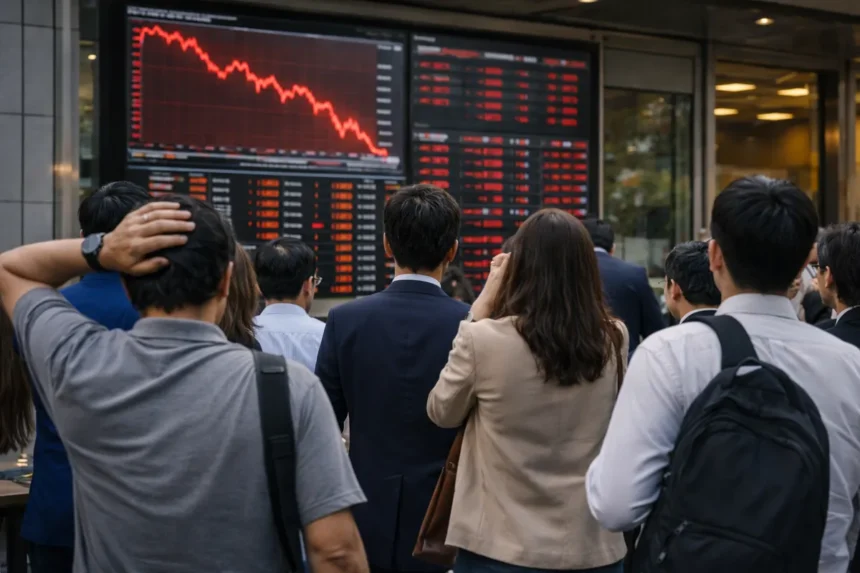
Shares of South Korean semiconductor giants SK Hynix and Samsung Electronics experienced a significant decline on Monday, erasing some of the gains from a record-setting rally the previous Friday. This profit-taking pullback followed one of the most volatile trading sessions in the history of the South Korean stock market.
By 9:15 AM in Seoul, Samsung Electronics saw its stock price drop by 6.48%, while SK Hynix fell by 6.69%. The broader KOSPI index also retreated, losing 4.25% in early trading. This downturn contrasted sharply with Friday’s remarkable performance, where Samsung’s stock surged 26.81% and SK Hynix experienced a 29.95% jump, hitting its upper trading limit. These advances propelled the KOSPI to its own record gain of 17.91%.
Friday’s Rebound Meets Market Realities
The dramatic gains on Friday occurred after the KOSPI had suffered substantial losses, shedding over 17% in the preceding three trading days. This steep decline had left semiconductor stocks technically oversold and potentially exposed short sellers. Positive earnings reports from major technology firms like Microsoft and Amazon also helped alleviate concerns that leading tech companies were poised to cut back on investments in artificial intelligence (AI) infrastructure.
Market data indicated significant activity from foreign investors, who net purchased 7.22 trillion won worth of Korean equities, alongside domestic institutions buying 1.15 trillion won. This influx of capital, combined with opportunistic bargain hunting and short-covering, fueled the market’s rapid ascent. Consequently, Monday’s profit-taking was seen by many as a natural and understandable reaction to such an extraordinary surge.
Analysts had anticipated a potential cooling-off period. Han Ji-young of Kiwoom Securities had previously suggested that investors might look to secure profits early in the week following the KOSPI’s unprecedented jump. Therefore, Monday’s decline does not necessarily indicate a fresh deterioration in the earnings outlook for the chipmakers. However, the inability to sustain even the initial gains after Friday’s rebound raises questions about whether the market has established a solid, durable floor.
Leverage and Sentiment Drive Market Volatility
A key risk factor highlighted by market observers is not necessarily collapsing corporate profits, but rather the prevailing market positioning and the role of leverage. Peter Kim, senior managing director at KB Securities, noted last week that the sell-off was not fundamentally driven but rather by fragile market sentiment and forced liquidations in single-stock leveraged exchange-traded funds (ETFs) both domestically and internationally.
Kim also cautioned that the substantial amount of leverage accumulated in the market suggested that the deleveraging process might extend beyond a few weeks. This assessment is critical because sharp, short-term rallies can sometimes tempt traders to re-establish positions before the pressure from margin calls has fully subsided. Such premature re-entry could exacerbate future downturns.
Evolving Investor Demands in the AI Era
In the current artificial intelligence market, investors are seeking more than just strong performance; they require clearer indicators of long-term prospects. Gary Tan, a portfolio manager at Allspring Global Investments, stated that investors are looking for concrete signals regarding long-term supply agreements, commitments to shareholder returns, and the sustained durability of the memory chip market cycle.
The underlying concerns that contributed to the initial sell-off have not disappeared. Investors continue to monitor several factors, including intensifying competition from Chinese memory chip manufacturers, advancements in domestic semiconductor manufacturing equipment within China, and the long-term sustainability of debt-fueled capital expenditure in the AI sector.
Chris Beauchamp, chief market analyst at IG, pointed out the potential threat posed by Chinese chipmakers. He suggested that these companies could eventually challenge established players by competing aggressively on price, potentially undercutting current market leaders.
A Premature Label for a ‘Bull Trap’?
Despite these longer-term concerns, the immediate outlook presents a less bearish picture for some. Alvin Nguyen, an analyst at Forrester, described the recent sell-off in memory stocks as an “overreaction.” He argued that manufacturers are still struggling to meet the immense demand for chips, with potential shortages persisting possibly until 2030. This persistent demand-supply imbalance suggests that labeling Friday’s rally as a definitive “bull trap” might be premature.
Friday’s surge appears to be more of an unstable relief rally than definitive proof of a lasting market recovery. While underlying earnings and demand for memory chips remain robust, market participants are now seeking concrete evidence that the forced deleveraging process is concluding, foreign investment is becoming more consistent, and major cloud providers (hyperscalers) are maintaining their commitment to AI spending. Until these conditions are met, the market’s path forward is likely to remain subject to significant volatility.