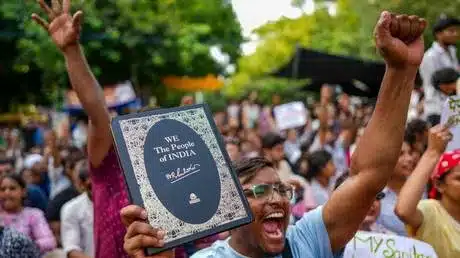
New Delhi has been the scene of significant unrest, marked by clashes between protesters and police, with injuries reported across various groups including demonstrators, law enforcement, and journalists. At the heart of the ongoing demonstrations is the Cockroach Janata Party (CJP), a movement that began as online satire but has rapidly evolved into a potent street force. Young people, many carrying CJP symbols, continue to gather in central Delhi despite a heavy security presence, engaging with authorities even as government officials attempt to de-escalate the situation.
NEET Exam Scandal Ignites Widespread Protests
The current wave of unrest was triggered by a major scandal involving the National Eligibility-cum-Entrance Test (NEET), an examination taken annually by over two million students vying for limited medical college seats. Allegations of a paper leak in May led to the exam’s cancellation and, tragically, are reported to have contributed to the suicides of numerous aspirants. This incident quickly became a focal point for the CJP, galvanizing public anger and drawing widespread attention, even though education reform was not the movement’s original premise.
Prime Minister Narendra Modi addressed the nation on Thursday, seeking to calm the escalating protests. He announced the government’s intention to establish fast-track courts to expedite action against those responsible for leaking the NEET examination papers. “Nothing is more important than the welfare and future of our youth. Those who try to harm the future of our youth will not be spared,” Modi stated in a post on X (formerly Twitter). Later that day, in a notable move, he released a video message promising the introduction of a new Anti-Paper Leak Bill in parliament. He further engaged with the public via Instagram, thanking young followers for their suggestions and reportedly gaining a significant number of new followers overnight.
Activist Ends Hunger Strike Amidst Negotiations
Sonam Wangchuk, a prominent climate activist and an emerging face of the Cockroach protests, concluded his 26-day hunger strike on Thursday. His fast was broken at Medanta Hospital in the presence of the Minister of Health and Family Welfare, J.P. Nadda, and the Minister of State in the Department of Atomic Energy, Jitendra Singh, who are representing the government in negotiations with the CJP. Wangchuk stated that he ended his fast after receiving assurances from the government and members of parliament regarding discussions on accountability in the examination system. He also secured assurances of adequate compensation for the families of suicide victims and a commitment that no cases would be registered against peacefully protesting students.
Wangchuk had been transferred to the hospital from the protest site at Jantar Mantar on July 18 due to deteriorating health, following medical advice and a Delhi High Court directive. Despite facing criticism from some protest supporters for ending his fast before all demands were met, Wangchuk explained in a subsequent video that his primary motivation was to prevent further violence and harm to protesters. He emphasized that his key demand was not the education minister’s resignation, but a government guarantee against future legal action for those who participated in the protests.
In response to the growing demonstrations, two major public universities in Delhi, Delhi University (DU) and Jawaharlal Nehru University (JNU), issued notices advising students and faculty against participating in rallies near Jantar Mantar, warning of potential legal repercussions and damage to future careers.
From Peaceful Sit-In to Violent Clashes
The demonstrations, which began in June as a peaceful sit-in at Jantar Mantar, escalated into violence and chaos earlier this week. On Monday, a march organized by the CJP towards the parliament building, coinciding with the start of its monsoon session, was met by police attempting to block the route with steel barricades. The situation quickly devolved into chaos, with police deploying batons and tear gas to disperse the crowds. Reports indicate that approximately 180 people were injured, including 118 security personnel and 60 protesters.
Footage emerged showing alleged attacks on police officers, leading to questions about the nature of the protests and the potential involvement of external elements. Several journalists covering the unrest also reported being harassed and attacked. While CJP members maintained that those involved in violence were not part of their peaceful contingent, opposition parties have called for accountability regarding the police response. Opposition leader Rahul Gandhi staged a sit-in outside the Prime Minister’s residence in solidarity with the protesters, stating that an attack on students is an attack on every Indian family. Gandhi was briefly detained by Delhi Police.
In the subsequent days, further unrest, including stone-pelting and attacks on police, led to heightened security measures in central Delhi, including the suspension of mobile internet services and the closure of metro stations near the protest site. Protests have also spread to other major Indian cities. Inside parliament, opposition members expressed solidarity with the arrested protesters, and various regional parties have publicly backed the CJP’s demands.
Government Engages in Dialogue, Takes Action
Government representatives, including J.P. Nadda and Jitendra Singh, held multiple rounds of meetings with CJP activists to address the escalating situation. The CJP presented key demands, including the resignation of the Union Education Minister Dharmendra Pradhan, compensation for the families of NEET aspirants who died by suicide, and the withdrawal of cases against student protesters. They also proposed reforms to the examination system, including stricter regulation of coaching centers and improved fairness and accessibility.
In response, the government has initiated several measures. The National Testing Agency (NTA) reportedly removed 47 officials, and legal proceedings are anticipated against some individuals. The Higher Education Secretary has been transferred, and a special judge has been appointed to hear cases related to the paper leaks. Despite these actions, barricades remained in place, and key metro stations and mobile connectivity in central Delhi were still affected, disrupting daily life.
Youth Aspirations at the Forefront
The core motivation behind the protests, as articulated by young participants, centers on the demand for fundamental changes in the education system. Many students view education as a crucial pathway out of poverty, and they express deep frustration when corruption and exam leaks undermine this aspiration. Aviyaan Chaudhary, a 23-year-old postgraduate student who traveled to Delhi to join the protest, highlighted how a corrupt education system dashes the dreams of upliftment for poor students.
Shweta Naran, an undergraduate student, echoed these sentiments, emphasizing that the students’ demands are genuine and concern the future of every young Indian, asserting that the movement should not be exploited for political gain. While the long-term trajectory of the movement remains uncertain, with some analysts suggesting it might lose momentum like previous large-scale protests, the immediate focus remains on the ongoing dialogue between the government and the CJP, and whether it will lead to a substantive resolution for the thousands of young people camped at Jantar Mantar.