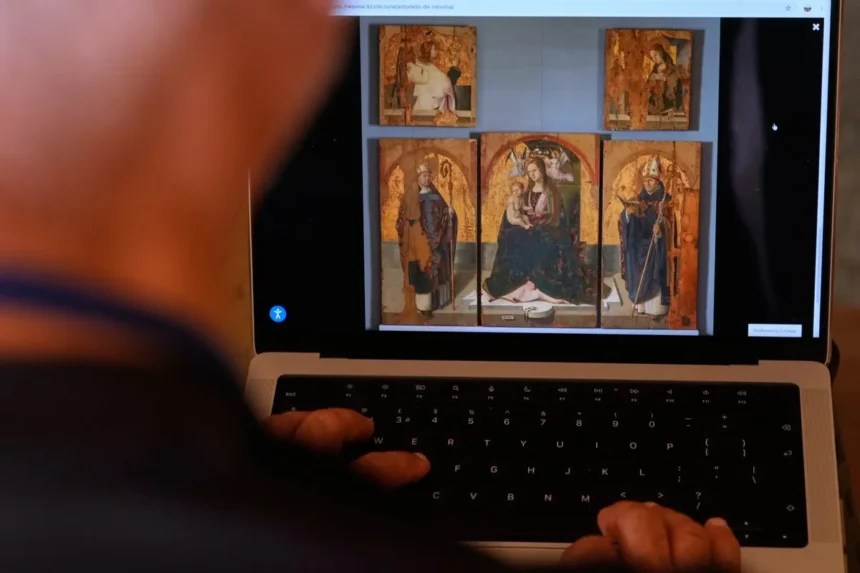
Four significant artworks attributed to the renowned Sicilian Renaissance painter Antonello da Messina were stolen from the MuMe regional museum in Messina, Sicily, during the Italian national holiday of Ferragosto. The theft, which occurred on Saturday evening, involved the bypassing of the museum’s security systems, according to reports from the news agency LaPresse. The stolen pieces include three panels from the 1473 San Gregorio Polyptych, one of only five surviving works of its kind by the artist, and a distinct double-sided panel featuring depictions of the Virgin Mary and Christ in Pietà, which was taken from a secure, armored case.
A Devastating Loss for Art and Culture
The director of the MuMe museum, Marisa Mercurio, expressed profound distress over the incident. Speaking to the news agency ANSA, Mercurio stated that the theft took place shortly before 10 p.m. on Saturday. “We are devastated by what happened,” she said. “They were two of Antonello da Messina’s most important and best-known works. It is a tremendous loss for the museum, the city, the community and the art world.” The value of these specific pieces is immense, not only monetarily but also culturally and historically, representing a significant blow to Sicily’s artistic heritage.
Antonello da Messina: A Painter of Renown
Antonello da Messina (c. 1430 – 1479) was a pivotal figure in the Italian Renaissance, particularly noted for his innovative use of oil painting techniques, which he is believed to have learned from Flemish artists. His work bridged the gap between the Early Netherlandish and Italian painting traditions. His realistic portrayal of figures and his mastery of light and shadow were highly influential. The Italian government recently underscored the painter’s importance by acquiring his devotional artwork “Ecce Homo” for $14.9 million from Sotheby’s in New York in March, highlighting the enduring value and recognition of his art on the international stage.
The Challenges of Selling Stolen Masterpieces
Art-crime experts suggest that the high profile and distinctiveness of Antonello da Messina’s works present a significant challenge for those who stole them. Lynda Albertson, chief executive of the ARCA (Art Crime Research Association), commented to the Italian newspaper La Repubblica that the recognizable nature of these pieces makes them exceedingly difficult to sell through legitimate channels. “Stealing an Antonello may be far easier than selling one,” Albertson noted. “If these are ordinary thieves, they will soon discover that — to their cost.” She further explained that such famous artworks are often not stolen with the intent of immediate resale on the open market. Instead, they can become valuable collateral or bargaining chips within criminal networks.
Security and Investigation
Following the discovery of the theft, the MuMe museum remained closed on Sunday to allow law enforcement and forensic teams to conduct a thorough investigation and collect evidence. At the time of the initial reports, neither museum staff nor the Carabinieri (Italian national police) were immediately available to provide further comment. The investigation will focus on identifying how the thieves managed to bypass the museum’s security measures and on tracing the stolen artworks. The timing of the heist during Ferragosto, a major Italian holiday when many institutions have reduced staffing and public attention is diverted, may have been a deliberate choice by the perpetrators.
Context of Art Thefts in Italy
This incident occurs against a backdrop of notable art thefts in Italy. Just recently, in March, stolen artworks by Impressionist masters Claude Monet, Pierre-Auguste Renoir, and Post-Impressionist Paul Cézanne, valued at approximately 10 million euros ($11.5 million), were recovered by police in Parma. That heist, which targeted the Magnani Rocca Foundation in the province of Parma, led to the detention of five individuals. The recovery of those valuable pieces demonstrates the efforts of Italian authorities to combat art crime, but the theft from the MuMe museum underscores the persistent threat to cultural heritage.
Ferragosto: A Time of Celebration and Vulnerability
Ferragosto, celebrated on August 15th, marks the Feast of the Assumption of Mary and is traditionally considered the peak of the Italian summer vacation period. It is a time when many Italians travel, and businesses, including museums, may operate with altered hours or reduced staff. While a period of festivity and relaxation for many, this can inadvertently create windows of opportunity for criminal activity, as tragically demonstrated by the theft of these irreplaceable Antonello da Messina works.
Conclusion
The theft of four Antonello da Messina artworks from the MuMe museum represents a significant cultural loss. The investigation is ongoing, with authorities working to recover the stolen pieces and apprehend those responsible. The incident highlights the ongoing challenges in protecting valuable art heritage, even within secure museum environments, and the complex dynamics of the illicit art market.