A significant portion of Republican voters believe that Donald Trump, at 80 years old, is too old to serve as President, according to a recent survey. The poll, conducted by JL Partners, reveals a nuanced perspective among GOP supporters regarding Trump’s age and his capacity to continue in office.
Republican Views on Trump’s Age
The survey found that 38 percent of Republicans polled think Donald Trump is too old to be President. However, these voters are not unified on what actions, if any, should be taken regarding his potential second term. While a substantial number express age concerns, the question of whether he should step down before completing a term reveals further division within the party.
Specifically, 51 percent of Republican respondents stated that Trump is not too old to be President. In contrast, 11 percent of Republicans believe he is too elderly and should not be allowed to finish his term. Another segment, comprising 27 percent of Republican respondents, feels he has “too many years under his belt” but still believes he should complete his second term if elected.
When all Republican responses are aggregated regarding the question of whether Trump is too old and should finish his term, the figure stands at 38 percent, aligning with the initial percentage who believe he is too old. This indicates a complex sentiment where age is a concern for many, but the implications for his presidency are debated.
Broader Public Opinion on Age and Presidency
The concerns about Trump’s age are not confined to the Republican base. When considering all respondents in the survey, regardless of political affiliation, 38 percent indicated that Trump is too old and should not finish his term. This suggests a broader public awareness and concern about the age of presidential candidates.
Among Democrats, the sentiment is more pronounced. A majority of Democrats, 59 percent, believe that Trump is too old to be President and should not finish his term. A smaller group of Democrats, 22 percent, feel he is too old but should be permitted to complete his second term if elected.
Independents also expressed significant concern. According to the poll, 40 percent of independent voters believe Trump is too old to be President and should not complete his term.
Context of Age and Health Concerns
These age-related discussions occur against a backdrop of scrutiny regarding Trump’s health. As he approaches the potential to become the oldest sitting U.S. President, various health matters have drawn attention.
Reported Health Incidents and Explanations
Recent public appearances have led to observations and questions about Trump’s physical well-being:
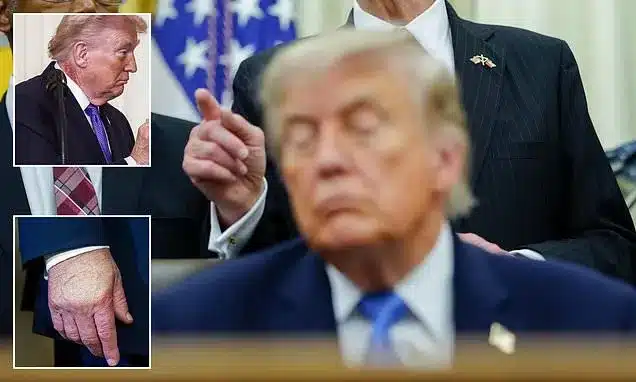
- Bruising on Hands: Trump has been observed with bruising on his hands, predominantly on his right hand. The White House attributes this to frequent handshaking and the use of aspirin.
- Ankle Swelling: Swelling in his lower legs led to a diagnosis of chronic venous insufficiency (CVI) in July 2025 following a health checkup. CVI is a condition where weakened vein valves cause blood to pool in the legs, a condition more common in older individuals.
- Neck Rash: Earlier in the year, a rash appeared around Trump’s neck. White House Physician Dr. Sean Barbella explained this was a result of a medicated cream used for preventative skin care.
Despite these public observations, Donald Trump has asserted his good health. Following a six-month physical examination at Walter Reed National Military Medical Center in May, he posted on Truth Social, stating, “Everything checked out perfectly.” Dr. Barbella corroborated this, declaring Trump to be in “excellent overall health” after the examination.
Historical Context of Presidential Age
If Donald Trump were to complete a full second term, he would surpass Joe Biden’s record as the oldest sitting President in U.S. history. This fact adds another layer to the ongoing discourse about age and fitness for the demanding role of the presidency.
Conclusion
The JL Partners survey highlights a significant segment of Republican voters who harbor reservations about Donald Trump’s age as a potential factor in his fitness for the presidency. While a majority of Republicans do not see his age as a disqualifier, a substantial minority does, and opinions diverge on the implications for his candidacy and potential term. These internal party views, coupled with broader public and Democratic sentiments, underscore the ongoing conversation surrounding age, health, and leadership in American politics.