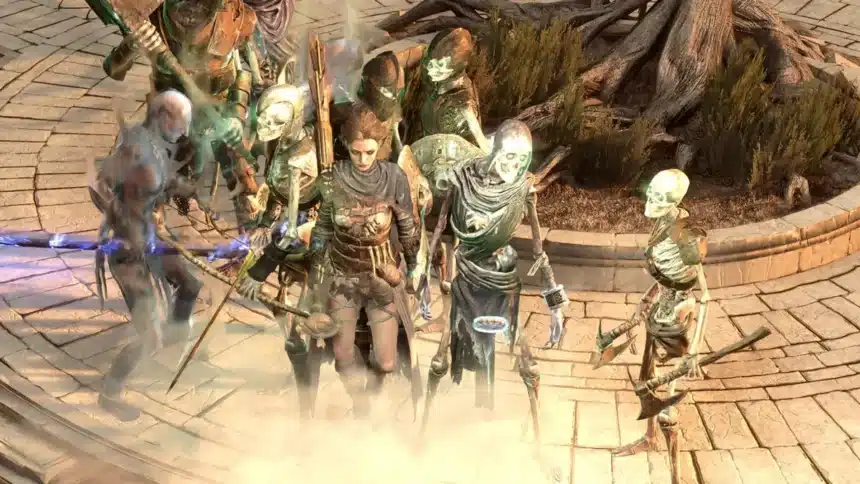
In a remarkable display of ambition and technical strain, a group of Path of Exile 2 players, led by streamer Empyriangaming, pushed the action RPG’s engine to its breaking point by summoning approximately 2,000 skeletal minions. This massive minion army, accumulated through extensive in-game currency investment and strategic resource manipulation, caused severe performance degradation, effectively rendering the game unplayable for extended periods. The experiment culminated in a unique trap designed to lure unsuspecting players into a lag-filled hideout.
Pushing the Limits of Minion Summoning
While many players of Path of Exile 2 engage with new leagues by progressing through standard gameplay, some opt for more unconventional pursuits. Empyriangaming, known for ambitious in-game experiments, invested a significant amount of in-game currency—reportedly more than a typical player earns in hundreds of hours—to acquire top-tier gear for an extreme minion build. The goal was to summon the maximum possible number of minions, far exceeding the typical 10 to 15 skeletons accompanying a player in standard builds.
The core strategy involved drastically reducing the resource cost for each minion to a single-digit figure, while simultaneously maximizing the player’s resource pool. However, Path of Exile 2 imposes a hard limit, preventing players from summoning more than 255 of any single minion type before they are automatically removed and the count resets. To overcome this limitation and achieve their goal of thousands of minions, Empyriangaming collaborated with several friends, each contributing their own armies.
Frame Rate Catastrophe Ensues
The initial summoning attempts quickly revealed a critical flaw: the game’s performance. When Empyriangaming alone summoned 255 Skeletal Priests, the game’s frame rate plummeted, creating a slideshow effect. The server struggled to keep up with the sheer volume of summoned entities, resulting in noticeable delays between player actions and on-screen responses. Despite the unplayable conditions, the group pressed on, seeking to further test the game’s limits.
The Trial of the Sekhemas Multiplier
The players then ventured into the game’s roguelike Trial of the Sekhemas mode. This mode offers powerful bonuses, including a buff that effectively doubles the number of minions a player can summon. By combining this buff with their existing minion-stacking strategies, the six-player group managed to collectively summon around 2,000 minions. The visual representation of this event was dramatic, with frame rate graphs fluctuating wildly, mirroring a heart rate monitor. The lag was so severe that basic actions, such as a dodge roll, could take an entire minute to register on screen. One player humorously remarked on the delay, stating, “Give me like 30 more seconds” to properly execute a dodge roll.
An Elaborate Trade Scam
Even when attempting to engage with standard game content, such as fighting a boss in a map, the performance issues persisted, making progress incredibly slow. Recognizing the unplayability, Empyriangaming devised a final, elaborate experiment back in his hideout. He instructed everyone to continuously spam skeleton summons while he listed an extremely valuable in-game item on the trade website at an absurdly low price.
The intention was to lure both automated bot accounts and unsuspecting human players into a trap. The bait worked effectively, with numerous players and bots flooding into the hideout, expecting a lucrative trade deal. Upon entering, they were met with a chaotic scene of hundreds of skeletons. The experience was jarring for many, with one player expressing their shock in chat: “Wtf is this.” While some players immediately left upon realizing the situation, at least one managed to acquire the item and escape the skeleton-filled room.
The Lingering Impact
The incident highlights the potential for extreme player-driven scenarios to strain even robust game engines. While Path of Exile 2 is not classified as a horror game, the experience of entering a hideout populated by an overwhelming number of skeletal minions may have left a lasting impression on those who fell victim to the trap. The event underscores the community’s capacity for creative, albeit disruptive, exploration of game mechanics and the technical boundaries of virtual worlds.










.png "I Let Google’s ‘Auto Browse’ AI Agent Take Over Chrome. It Didn’t Fairly Click on")