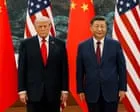
During a high-profile welcome ceremony in Tiananmen Square, Donald Trump and Xi Jinping donned nearly identical blue single-breasted suits with flap pockets, two buttons featuring only the top one fastened, and bold red ties. This visual symmetry stood out amid a sea of varied attire: Stephen Miller sported his signature pocket square, Pete Hegseth and Scott Bessent opted for flashy striped ties, and Elon Musk chose a green tie alongside blue shirts and black suits.
Psychological Power of Mirroring
Enda Young, founder and CEO of the Centre for Negotiation and Leadership and a negotiation lecturer at Oxford University, highlights how such similarities foster rapport. “There’s strong evidence from social psychology that people warm to those who appear similar, whether in behavior, language, posture, or dress,” Young explains. In negotiations, mirroring operates subconsciously, signaling alignment, shared status, and respect before words are exchanged.
Young references the “chameleon effect,” where subtle mimicry boosts cooperation and trust. He also cites Robert Cialdini’s Influence: The Psychology of Persuasion and its “liking” principle, which links similarity to greater openness and influence.
Historical Precedents in Diplomacy
Leaders have long used matching outfits strategically. France’s Emmanuel Macron and Brazil’s Luiz Inácio Lula da Silva coordinated looks during 2024 Amazon talks on ecological preservation and global taxes, fueling perceptions of their close alliance, complete with hand-holding.
Conversely, Volodymyr Zelenskyy’s military-style black sweatshirt at the Oval Office last year drew criticism during a tense meeting. He later switched to a militarized suit, signaling a diplomatic adjustment.
Mirroring risks backfiring if it seems forced. Liz Truss faced backlash for a dress resembling one worn by a fictional dictator during her first speech as UK prime minister.
“Mirroring works best when it feels natural,” Young cautions. “Staged efforts often provoke resistance.” Notably, both leaders’ choices aligned with their typical wardrobes—Trump’s consistent style and Xi’s range, from windbreakers to Mao suits worn last year with Vladimir Putin and Kim Jong-un.
Talks Progress with Shifting Styles
Following initial discussions, Xi emphasized partnership: “Our two countries should be partners rather than rivals.” By day two, with no major deals announced, Trump described them as “true friends.” Their suits diverged—Xi stayed consistent, while Trump’s jacket hung open over a striped blue tie.