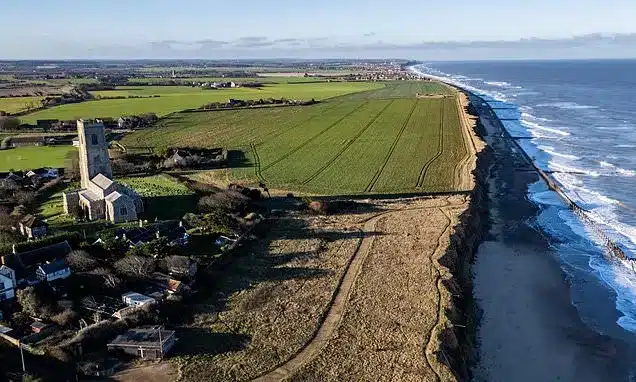
The final resting places of 119 sailors lost at sea two centuries ago are under threat from severe coastal erosion, prompting urgent discussions about their potential exhumation. The sailors, who perished when the warship HMS Invincible met its fate off the Norfolk coast in 1801, were buried in the churchyard of St Mary’s in Happisburgh. Their graves are among hundreds facing inundation as the coastline continues to recede.
Historic Naval Tragedy and Present Danger
The sinking of HMS Invincible occurred as the vessel was en route to join Admiral Nelson’s fleet for the Battle of Copenhagen. Reports indicate the ship’s pilot disregarded warnings about shallow sandbanks, leading to the disaster. Of the 590 crew members aboard, only 190 survived. Those sailors whose remains were recovered were interred in Happisburgh, the closest village to the tragedy at the time.
Now, the very ground where these sailors lie is being eroded by the sea. This issue extends beyond the naval graves, impacting numerous clifftop cemeteries along the Norfolk coast. Villages like Happisburgh are experiencing significant land loss, with homes and amenities succumbing to the relentless erosion. Anguished relatives fear their loved ones’ remains could be washed away, expressing concern over the perceived lack of decisive action from authorities.
Broader Impact on Local Cemeteries
The threat is not confined to the 1801 shipwreck victims. Graves of soldiers who died in World War I and World War II are also at risk. Three churchyards, along with their respective churches, in Happisburgh, Trimingham, and Mundesley, are all projected to be engulfed by the sea within the coming decades.
Efforts to Preserve Naval Heritage
The 1805 Club, an organization dedicated to preserving naval heritage from the Georgian era, has formally proposed the exhumation and reburial at sea of the 119 sailors’ remains. In response, North Norfolk District Council has indicated plans to conduct a ground-penetrating radar survey of the graveyard later this summer. The aim is to precisely locate the mass grave.
Local Concerns and Official Responses
Some local residents in Happisburgh have raised objections to suggestions that the St Mary the Virgin churchyard is not under immediate threat, with recent events indicating a more pressing timeline. The church itself is also vulnerable to coastal erosion.
North Norfolk District Council has engaged coastal consultants to collaborate with affected communities on strategies to address the erosion. Potential solutions include exhuming and reburying remains elsewhere. Alternative approaches under consideration range from a ‘do-minimum’ strategy, involving no action until the threat becomes immediate, to ‘long-term management,’ which acknowledges the potential loss of burial sites and the impossibility of exhuming all remains.
Consultations with residents and other stakeholders are currently underway. One local resident, whose grandparents are buried at St Mary’s and whose parents’ ashes are interred there, conveyed the fear and sensitivity surrounding the issue. “People are frightened, it’s such a sensitive issue,” they stated, emphasizing the need for collective decision-making involving all with a connection to the site.
Frank Mason, 69, whose parents are buried in the churchyard, believes the graves should be relocated, suggesting a nearby water tower site. He expressed concern that the churchyard could face collapse into the sea within two decades, a timeline that appears to conflict with official estimates.
Contrasting Timelines and Future Uncertainty
While recent government maps on coastal erosion in Happisburgh do not indicate an immediate threat to the churchyard, they do forecast significant land loss by 2055, with almost the entire churchyard potentially gone by 2105. The churchyard is currently approximately 80 meters from the cliff edge.
Among those buried are soldiers from the World Wars, including Private William J Millar (WWI) and Royal Navy seaman William Marsh (WWII). The Commonwealth War Graves Commission has stated that exhuming and relocating soldiers’ remains is considered an “absolute last resort.” A spokesperson for the commission outlined a rigorous process for such decisions, involving extensive assessments, consultation with military authorities, government bodies, and landowners, and efforts to inform next of kin.
Paul Betts, a member of a local coastal research group, acknowledged the difficult choices ahead. “We know it [coastal erosion] is going to happen but we have to think about what mitigation we can put in place,” he said, highlighting the emotive nature of the situation for families with relatives interred in the churchyard.
Community Impact and Defence Challenges
The village of Happisburgh has already witnessed the loss of approximately 35 homes to coastal erosion over the past two decades. A new car park was recently established after the previous one collapsed into the sea. Residents note that the presence of a Site of Special Scientific Interest (SSSI) along the coast, which restricts the implementation of certain defence measures, exacerbates the problem.
Bryony Nierop-Reading, 80, has already lost a second home to coastal erosion and is now facing the potential loss of her current property, the Old Coastguard House. She has been a vocal advocate for preserving the village, emphasizing the importance of remaining engaged with the issue.
The cost of exhuming around 100 bodies over a four-week period has been estimated at approximately £103,000. Despite the ongoing risks, burials continue to take place at St Mary’s. Any decisions regarding the relocation of existing burials are expected to involve years of assessments, consultations, and complex efforts to locate descendants of those laid to rest.
A spokesperson for North Norfolk District Council acknowledged the sensitivity of the issue, stating that the council, through the Coastwise scheme, is working with the Diocese of Norwich to support affected communities and churches.