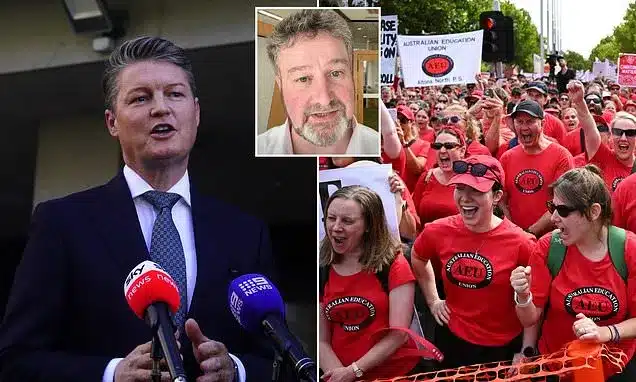
Tens of thousands of teachers across Victoria are poised to walk off the job on Thursday, disrupting education for many families as they protest working conditions and reject a proposed pay increase. The industrial action by members of the Australian Education Union (AEU) Victorian branch follows the rejection of a government offer that included a 28.3 per cent pay rise over four years.
Teachers Reject Government Pay Offer
The AEU’s Victorian members narrowly voted to reject the government’s latest proposal. The offer, which aimed to address a long-standing pay dispute, would have seen salaries for over 90,000 teachers increase incrementally, reaching an additional $3,000 per month by 2030. However, a slim majority of 51 per cent of union members decided against accepting the deal, opting instead for further industrial action.
Current teacher salaries in Victoria range from $78,021 to $126,992 annually, with principals eligible to earn up to $236,313. The union had initially sought a 35 per cent pay increase over four years, having previously turned down an earlier offer of 18.5 per cent over three years. The union argues that the proposed increases do not adequately address significant staffing shortages and resourcing pressures that have led to excessive workloads.
Union’s Stance on Working Conditions
Justin Mullaly, president of the AEU’s Victorian branch, stated that educators are demanding a more substantial offer to tackle the critical issues of staffing and resources. “They’ve had a gutful,” Mullaly commented to reporters, emphasizing that members feel they are bearing the brunt of increased demands without sufficient support. He highlighted that the majority decision to reject the offer reflects deep dissatisfaction among educators.
The dispute has been ongoing for nearly a year. A key point of contention is the pay for graduate teachers, who reportedly earn approximately $13,000 less annually than their counterparts in the Northern Territory, where salaries are among the highest in the country. This disparity fuels the union’s push for better remuneration and working conditions.
Disruption Expected for Victorian Schools
The planned strike is expected to cause significant disruption to public schools across Victoria. While the Department of Education has stated that all public schools are anticipated to remain open, many will only be able to offer limited supervision for students. Schools have been advised to communicate directly with parents and carers regarding any changes to their usual programs and class schedules.
For instance, parents at Blackburn High School received an email from Principal Joanna Alexander indicating that regular classes would be cancelled for all students except those in Year 7. Students in Years 8 through 12 were not required to attend school on the day of the strike. The school offered to discuss support options for families facing difficulties, particularly those working in critical services.
Government Urges Union to Reconsider
Victoria’s Deputy Premier and Education Minister, Ben Carroll, expressed disappointment with the union’s decision to proceed with the strike. He urged the AEU leadership to call off the industrial action, asserting that the rejected deal would have positioned Victorian teachers and education support staff as the highest paid in the nation, coupled with superior working conditions. “Students should be in classrooms and parents shouldn’t be left scrambling for childcare or losing a day’s pay,” Carroll stated.
The Minister emphasized the government’s commitment to ensuring students remain in education and that parents are not unduly burdened. He reiterated that the proposed offer was substantial and aimed to provide the best package for educators nationwide.
Background of the Dispute
Thursday’s strike is reminiscent of a similar action in March, which saw over 35,000 teachers, principals, and education support staff participate in a walkout – the first of its kind in 13 years. In June, teachers voted down a revised offer from the state government, even after their union had reached an in-principle agreement. The latest statewide strike was announced following the government’s tabling of another pay offer shortly before the planned action.
Some educators, like Liz Walsh, a member of Socialists in Schools, welcomed the rejection of the offer. She articulated that teachers have endured falling wages relative to inflation and critical workload pressures for an extended period, leading many to leave the profession. Walsh views the current action as an opportunity to advocate for necessary changes and improve the situation for educators.
Unionised public school educators are scheduled to gather in Melbourne’s CBD for a rally on Thursday, coinciding with the statewide strike. This demonstration is intended to amplify their demands for better pay, improved working conditions, and increased staffing and resources within the Victorian education system.