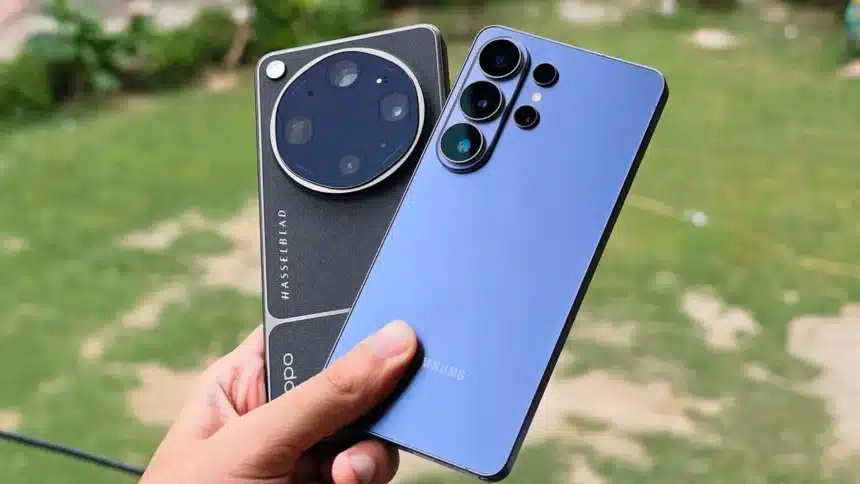
A comprehensive comparison pitting the Samsung Galaxy S26 Ultra against the Oppo Find X9 Ultra reveals a clear victor in the realm of smartphone photography. After capturing over 500 images with both devices, the results indicate that while Samsung’s latest flagship holds its own in certain aspects, the Oppo Find X9 Ultra consistently delivers superior image quality.
Camera Hardware and Software Strategies Compared
The Samsung Galaxy S26 Ultra focuses on a refined software experience, complemented by larger apertures on its camera sensors. In contrast, Oppo has opted for significant hardware upgrades in the Find X9 Ultra, paired with notable software advancements. A key differentiator is Oppo’s inclusion of a 10x optical zoom lens, a feature unique to its ‘Ultra’ line in 2026. Oppo claims this 10x telephoto camera offers 3x greater light sensitivity than its predecessor on the Galaxy S23 Ultra, suggesting a significant advantage in low-light and zoom performance.
Detailed Camera Specifications
The Samsung Galaxy S26 Ultra boasts a versatile focal length range from 13mm to 111mm. Its camera system includes a 50MP 13mm f/1.9 ultra-wide lens with a 1/2.5-inch sensor, a 200MP 23mm f/1.4 main camera with a 1/1.3-inch sensor, a 10MP 67mm f/2.4 3x telephoto lens with a 1/3.94-inch sensor, and a 50MP 111mm f/2.9 5x periscope telephoto lens with a 1/2.52-inch sensor.
The Oppo Find X9 Ultra expands its focal length coverage from 14mm to an impressive 230mm. Its specifications feature a 50MP 14mm f/2 ultra-wide lens with a 1/1.95-inch sensor, a 200MP 23mm f/1.5 main camera with a 1/1.2-inch sensor, a 200MP 70mm f/2.2 3x telephoto lens with a 1/1.28-inch sensor, and a 50MP 230mm f/3.5 10x telephoto lens with a 1/2.75-inch sensor.
Main Camera Performance
Both devices capture pixel-binned images by default from their 200MP main sensors. While higher resolution modes are available, the default settings were used for this comparison. The Galaxy S26 Ultra tends to boost color saturation for a more vibrant look, whereas the Find X9 Ultra produces more natural-looking images. Although Samsung’s contrast is appealing, some artificial color sharpening is noticeable. The Find X9 Ultra offers a more pleasing bokeh effect, attributed to its larger sensor. Both phones capture good detail, but Oppo’s color science and ‘Master Mode’ provide more natural tones with less artificial processing.
Low-Light Photography
In evening shots, the Galaxy S26 Ultra sometimes imparts a teal hue, while the Find X9 Ultra can lean towards a pink hue. Skin tones are generally better rendered by the Oppo, with more detail, whereas Samsung’s shots can appear slightly noisy. Despite Samsung’s efforts to improve night mode, the Find X9 Ultra’s ‘Master Mode’ consistently outperforms default processing in low-light scenarios, avoiding overexposure and delivering a more natural representation of night scenes. Samsung’s saturated colors in certain low-light situations, like on an entrance board, are preferred by some for maintaining a ‘low-light’ aesthetic over artificially brightened images.
Telephoto and Macro Capabilities
The telephoto performance provides a mixed bag. Samsung’s cooler tone is preferred over Oppo’s warmer look in some instances, though Oppo’s shots often capture richer details. In challenging lighting, such as during the golden hour, the Galaxy S26 Ultra excels at capturing the desired warm light, while the Find X9 Ultra’s image can appear washed out.
However, Oppo’s larger lens and processing shine in capturing intricate details. Samsung struggled to focus on fine textures like spiderwebs, a task the Find X9 Ultra accomplished with ease. This advantage extends to macro photography, where the Oppo Find X9 Ultra demonstrably outperforms the Galaxy S26 Ultra. Capturing small, moving subjects like a delicate flower proved challenging for the Samsung, with the Oppo successfully focusing and rendering even the finest details.
The 10x telephoto lens on the Find X9 Ultra is particularly impressive for close-up shots, enabling the capture of subjects invisible to the naked eye. Oppo’s macro mode is considered on par with leading competitors, a capability that Samsung currently lacks.
Ultra-Wide Camera Performance
In ultra-wide shots, the Oppo Find X9 Ultra achieves greater contrast, accentuating the sky’s blues without overexposing foliage. It also captures more detail on tree trunks and avoids overexposure of leaves. While Samsung’s processing better exposes leaves and avoids a halo effect, Oppo’s overall ultra-wide image quality is preferred for its detail and balanced exposure.
Conclusion
The Oppo Find X9 Ultra consistently captures richer details and excels in a majority of photographic scenarios when compared to the Samsung Galaxy S26 Ultra. While Samsung’s flagship offers pleasant surprises and holds its own on occasion, Oppo’s advancements in hardware and software, particularly its exceptional telephoto and macro capabilities, position it as the current leader in smartphone camera technology. The ‘Master Mode’ further enhances its appeal for those seeking film-like color reproduction.